Why teeth are filed down for crowns, and when it can be avoided
The viral "shark teeth" photos shock people, and they are meant to. They show a real step in fitting crowns. The question worth asking is whether those teeth needed crowns at all.
 Checked for accuracy by Dt. Hüseyin Yavuz Özbek, our implant surgeon · Last updated October 2026
A crown is a cap that covers the whole tooth, so the dentist has to remove a layer from every side, usually around 1 to 2 mm, to make room for it. That is why prepared teeth look small and pointed. It is normal for a crown, but it is permanent, and many healthy front teeth can be treated with bonding or thin veneers that remove much less tooth or none.
Teeth are filed down for crowns because a crown is a cap that has to fit over the whole tooth. To make room for it, the dentist removes a layer of tooth from the front, back, sides and biting edge. On a front tooth that leaves a small, tapered stump, which is what you see in the "shark teeth" photos that went viral on TikTok and Instagram. The look is normal for crown work. What is not always normal is crowning healthy teeth in the first place. As a Turkish dental clinic, here is how we explain it to UK patients who send us those photos.
What a crown actually needs
A crown is a shell made of ceramic, such as zirconia or E-max, or a ceramic on a metal base. It has to be thick enough not to crack under biting forces, and it has to look like a tooth of normal size once it is on. If the dentist simply glued a crown over an untouched tooth, the result would be bulky, and the gum around it would struggle to stay healthy.
So the tooth is made smaller by about the thickness of the crown. The exact amount depends on the material and the tooth, but it is usually somewhere around 1 to 2 mm on each surface, a little more at the biting edge. The Oral Health Foundation describes this step plainly: the tooth is shaped under local anaesthetic, an impression or scan is taken, and the crown is made to fit.
There is also a design rule. The walls of the prepared tooth are tapered slightly towards the tip, so the crown can slide on and seat fully. Taper plus reduction on every side gives that pointed outline.
Why the stumps look so dramatic
A few things make the photos look worse than people expect:
- Front teeth are thin. An upper front tooth is only a few millimetres thick from front to back. Remove 1 mm or more from each side and very little is left in the middle.
- Old fillings come out. If a tooth had fillings, those are removed and any decay under them is cleaned out, so the stump can be smaller still.
- Many teeth at once. One prepared tooth looks unremarkable. Twenty in a row look like a jaw of fangs.
- No temporaries yet. The photos are usually taken in the short gap before temporary crowns go on, which is the most exposed the teeth will ever look.
Temporary crowns matter here. They are fitted the same day, usually made of acrylic or composite, and they protect the prepared teeth from cold, keep the gums in shape and let you try out the new length and outline while the final crowns are made. Patients rarely walk around with bare stumps for more than an hour or two. The photos capture a moment, not a stage you live with.
So the stumps in a viral photo are not proof of bad dentistry. A carefully prepared tooth for a full crown can look exactly like that. But the photos do show something important: a large amount of healthy tooth can be removed in one sitting, and it never comes back.
How much tooth each option removes
The research gives a clear picture. In a widely cited laboratory study, Edelhoff and Sorensen (2002) measured the share of tooth structure removed by different preparations on upper front teeth. Full crowns removed far more tooth than thin veneers did. The pattern is the same in later work: the more of the tooth you cover, the more you have to remove.
| Treatment | Where tooth is removed | Rough amount |
|---|---|---|
| Composite bonding | Usually none, sometimes light polishing | Little or nothing |
| Laminate veneer | Front surface, sometimes the edge | Often under 1 mm, mostly in enamel |
| Full crown | Every surface | Around 1 to 2 mm all round |
Keeping enamel matters for more than looks. Bonding to enamel is stronger than bonding to dentine, and a thin veneer that stays mostly in enamel tends to behave better over time. A tooth that keeps more of its own structure is also less likely to have nerve problems.
What filing does to the nerve
Inside every tooth is the pulp, with nerves and blood vessels. Preparing a tooth produces heat and vibration, and the closer the preparation gets to the pulp, the more stress it is under. Usually the pulp copes. Sometimes it does not, and the tooth becomes sensitive or dies, which can happen weeks or years later.
A tooth whose nerve dies needs root canal treatment. The NHS describes this as removing infected or dead pulp from inside the tooth and sealing it. With a crown in place, that often means drilling through the crown, and in some cases remaking it. This is one of the main reasons UK dentists warn against crowning healthy teeth for cosmetic reasons. You are not only removing tooth now, you are raising the chance of further treatment later. We look at the long-term picture in Turkish teeth ten years on.
When crowns are the right answer
None of this means crowns are bad. For some teeth they are the best option, and leaving them unprotected would be the bigger risk. Crowns usually make sense for:
- Teeth that are already heavily filled, where there is little natural tooth to bond a veneer to.
- Broken or cracked teeth that need holding together.
- Back teeth after root canal treatment, which are more likely to split.
- Badly worn teeth where the bite has collapsed and needs rebuilding.
- Teeth that are a very different colour inside, where a thin veneer would not hide the shade.
In those cases much of the tooth may already be filling or damage, so the "filing" removes less healthy tissue than it would on a perfect tooth.
When filing can be avoided
For a healthy front tooth that is only the wrong colour, slightly crooked or a little short, a full crown is usually more treatment than needed. Options that remove less tooth include:
- Whitening for colour alone, if the teeth are otherwise sound.
- Composite bonding to close small gaps, repair chips or reshape edges.
- Laminate veneers for colour and shape changes on teeth with good enamel.
- Orthodontics such as aligners, if crowding is the main issue.
The trade-off is that these options may not produce the very bright, very uniform look people associate with "Turkish teeth". They tend to look more natural, and they keep more of your own tooth for the future.
How our dentists decide
At our clinic, each tooth is assessed separately on the 3D scan and X-rays. Our dentists prefer to keep a healthy tooth rather than crown it, and Dt. Hüseyin Bayram, whose work centres on veneers, crowns and smile makeovers, prefers to keep natural tooth where the case allows. Your written plan names every tooth and what is proposed for it, so you can see where crowns are planned and where veneers or bonding are enough. You can preview the shape and shade with digital smile design before any tooth is touched.
For reference, an E-max laminate veneer is £300 per tooth, composite bonding is £125 per tooth, and a zirconia crown is £150 per tooth. Our veneers and full mouth crowns pages explain each in more detail.
Questions to ask before anyone picks up a drill
- Why a crown on this tooth? Ask for the reason, tooth by tooth.
- Would a veneer or bonding work instead? If not, ask why not.
- How much will be removed? A good dentist can explain this in plain terms.
- What happens if the nerve reacts? Ask how root canal treatment would be handled.
- Can I see the planned result first? A mock-up or digital design should come before preparation.
The shark teeth photos are a useful warning. Not because filing is always wrong, but because it is permanent. Make sure it is the right choice for each tooth before it happens.
Sources
- Edelhoff D, Sorensen JA. Tooth structure removal associated with various preparation designs for anterior teeth. J Prosthet Dent 2002
- Oral Health Foundation: Crowns
- Oral Health Foundation: Veneers
- NHS: Root canal treatment
Checked October 2026. Where we give our own view as a clinic, we say so.
Common questions
Do the stumps in "shark teeth" photos mean the dentist did something wrong?
Not by itself. Any tooth prepared for a full crown looks smaller and tapered. The real question is whether those teeth needed full crowns, and whether too much was removed.
Does filing teeth down hurt?
It is done under local anaesthetic, so you should feel pressure and vibration rather than pain. Some teeth are sensitive for a while afterwards.
Can filed-down teeth grow back?
No. Enamel does not regrow. A tooth prepared for a crown will need a crown, or a replacement crown, for the rest of its life.
How much tooth does a veneer remove compared with a crown?
A laminate veneer usually removes a thin layer from the front only, often well under 1 mm. A full crown removes tooth from every side. Lab studies such as Edelhoff and Sorensen (2002) found crowns removed several times more tooth than veneers on front teeth.
Will you crown healthy teeth if I ask for it?
Our dentists will explain the options and will usually recommend the least invasive one that gives the result you want. We prefer to keep healthy teeth. See our veneers page for the alternative.
Related pages on our clinic site
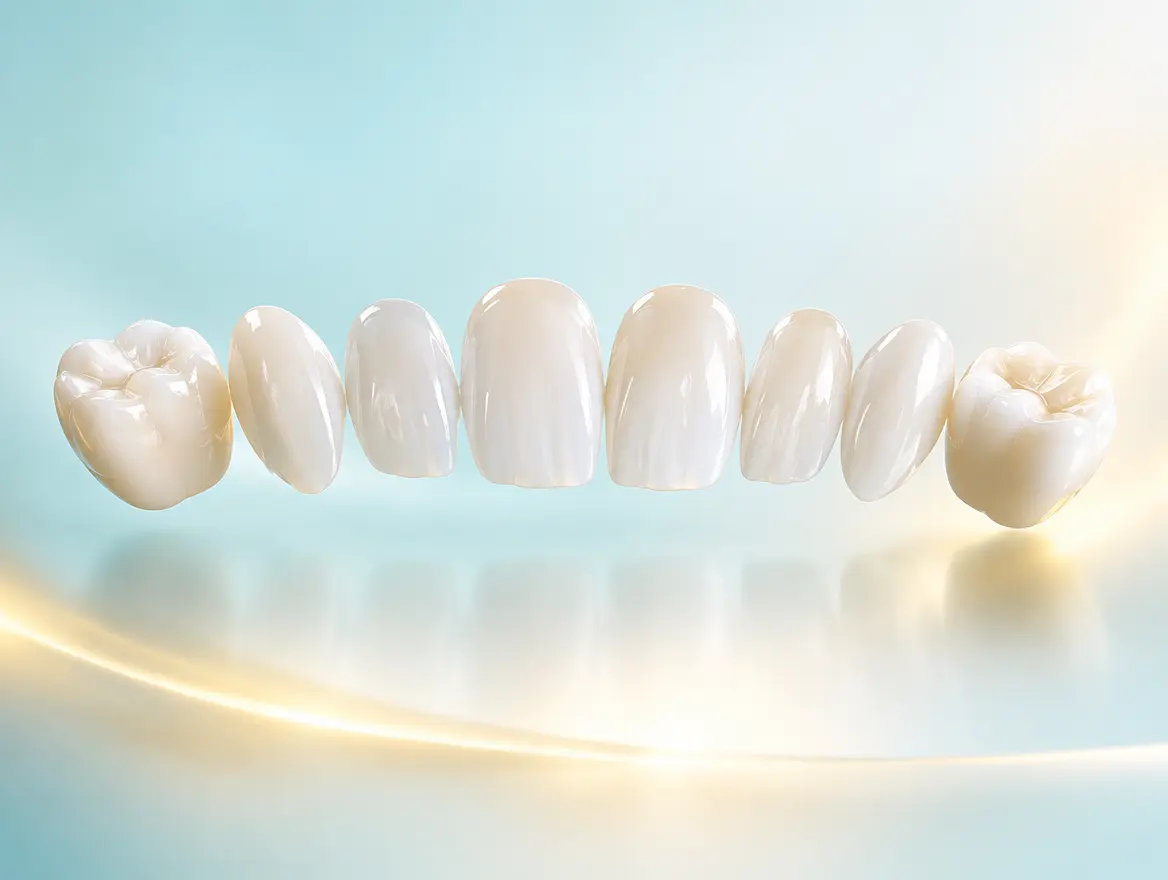
Turkish veneers
E-max laminate veneers, and an honest answer on whether you need crowns instead.
Find out more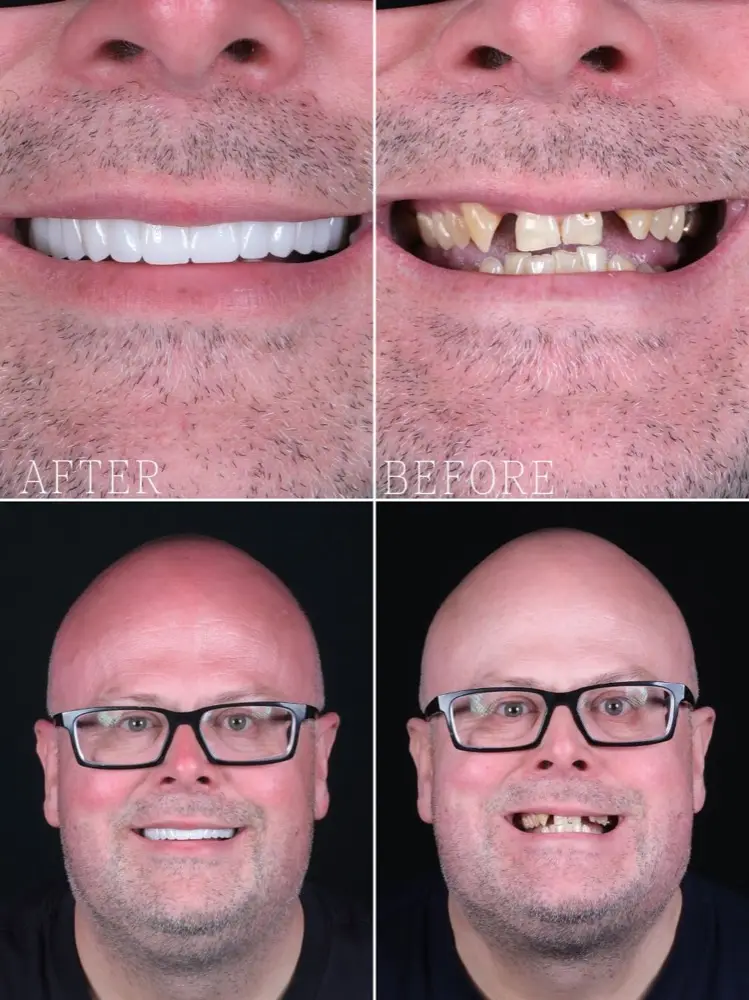
Full mouth crowns
A full set of zirconia crowns, counted tooth by tooth, in one 5-night trip.
Find out more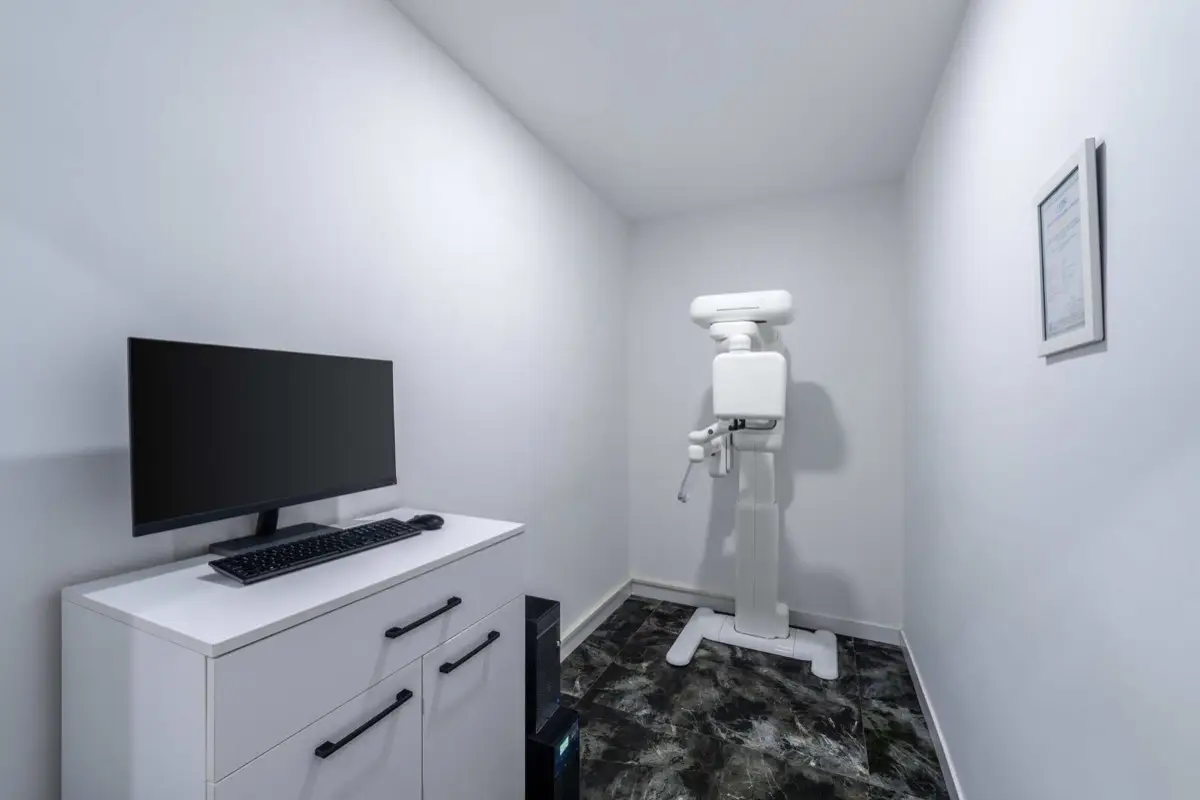
Digital smile design
Photos, a 3D scan and a preview of your new smile before any tooth is touched.
Find out moreAsk a Turkish dentist for a free written plan
Phone photos of your smile or an old X-ray are enough. You get the treatment, the implant brand and the price in pounds on paper, with no obligation to book.