Can Turkish teeth be undone?
Some people regret the colour, some the shape, some the fact that it was done at all. The honest answer depends on what was fitted, and for crowns it is not the answer most people hope for.
 Checked for accuracy by Dt. Hüseyin Yavuz Özbek, our implant surgeon · Last updated October 2026
Crowns cannot be truly undone, because the tooth under them was reduced on every side and enamel does not grow back. A crowned tooth will always need a crown. What can be changed is the crown itself: a new shade, a more natural shape, a better fit, or different treatment for teeth that have since failed. Composite bonding, by contrast, can often be removed.
If your "Turkish teeth" are crowns, they cannot be undone in the sense of going back to the teeth you had before. To fit a crown, the dentist reduces the tooth on every side, and enamel never grows back. That tooth will need a crown, or something like it, for life. What can be changed is the crown: its colour, shape, size and fit. If your work was composite bonding, the picture is much better, because bonding can often be removed. As a Turkish dental clinic we are asked this regularly, often by people who had treatment somewhere else. Here is the honest version.
First, find out what you actually have
The phrase "Turkish teeth" covers several treatments, and the answer to "can it be reversed?" depends entirely on which one you had. Many people were told they were getting veneers and later found out they had crowns. Here is a rough guide:
| What was fitted | Can it be removed? | What is left underneath |
|---|---|---|
| Composite bonding | Usually, by polishing it away | Mostly your own tooth, sometimes slightly roughened |
| Thin laminate veneers | Yes, but they must be replaced | A tooth reduced on the front, often still close to its shape |
| Full crowns | Yes, but they must be replaced | A small, tapered stump that cannot be left bare |
If you are not sure, your paperwork should say. If you have none, a dentist can usually tell from a look and an X-ray. Crowns cover the whole tooth down to the gum, and on an X-ray the outline of the prepared tooth inside is often visible. Bonding sits on the surface and is often thicker at the edges.
Why crowns are a one-way street
A crown needs room. The Oral Health Foundation explains that the tooth is shaped so the crown can fit over it, and that means removing a layer from every surface. Lab research by Edelhoff and Sorensen found full crowns on front teeth removed a large share of the tooth's structure, much more than veneers did.
Without that covering, a prepared tooth is a poor thing to live with. It is small and pointed, so it looks wrong. The dentine is exposed, so it is often sensitive to cold and sweet. Dentine is softer than enamel, so it wears and decays more easily. And the bite no longer works, because the teeth are not touching where they should. That is why no dentist will simply take crowns off and leave the teeth bare. "Undoing" crowns always means replacing them.
What can be changed
The good news is that most of the things people dislike about their crowns are properties of the crowns, not of the teeth underneath. A new set can change:
- Colour. Very bright crowns can be replaced with a softer shade that matches your age and your remaining natural teeth. The colour of a finished ceramic crown cannot be altered, so this needs new crowns.
- Shape. Square, uniform crowns can be remade with gentle variation between teeth, rounded corners and a more natural edge.
- Size. Crowns that were made too long or too bulky can sometimes be made smaller, within the limits of the tooth stump underneath.
- Fit at the gum. Crowns with poor edges that trap food or irritate the gum can be remade with better margins, once the gum has healed.
- Number. A smile does not have to be all crowns. Teeth that were left untouched can stay that way, and in some cases a mix of crowns and veneers looks more natural.
You do not always have to redo everything. If the front six teeth bother you and the back crowns fit well and are healthy, it may be sensible to replace only the ones that show. The new crowns are then matched to the old ones further back, or to your natural teeth. If a crown edge has been irritating the gum, the dentist may want the gum to settle for a few weeks with a temporary before the final crown is made, so the new edge sits in the right place.
It also helps to be clear about why you want a change. A crown you dislike the look of is a different problem from a crown that hurts, rocks or traps food. Pain, swelling or a bad taste around a crown should be checked by a dentist promptly, wherever you are, because it can mean decay or infection under the crown rather than a cosmetic issue.
What usually cannot be changed
Some limits are set by what was done before:
- The amount of tooth. If a lot was removed, the new crown has to be at least as large, and the tooth may need a post or a build-up to hold it.
- Nerves that have died. A tooth whose nerve was damaged by preparation will need root canal treatment, which the NHS describes as removing dead or infected pulp and sealing the tooth.
- Gum that has receded. Gum lost after treatment does not usually grow back on its own. The crown edge can be placed better, but the gum line may stay where it is.
- Teeth that cannot be saved. Sometimes a tooth uncovered under an old crown is too decayed or cracked to keep. Then the choice is between a bridge, an implant or leaving a gap.
What redoing crowns involves
Replacing crowns is a bigger job than fitting them the first time, because the old ones have to be cut off and each tooth reassessed. The usual steps are:
- Assessment. X-rays, ideally a 3D scan, and a look at the gums and the bite.
- Removal. The old crowns are cut away under local anaesthetic.
- Checking each tooth. Decay is cleaned out, nerves are tested, and any tooth that needs root canal treatment is identified.
- Temporaries. Temporary crowns protect the teeth and let you try the new shape.
- New crowns. The final crowns are made and fitted, with bite checks.
The final plan can change once the old crowns are off, because some problems only show up when the tooth is uncovered. A good clinic will tell you that in advance rather than surprise you on the day.
If you are only thinking about treatment
If you have not had anything done yet, this is the most useful thing to take from this article. Treatment that removes little or no tooth keeps your options open. Treatment that crowns healthy teeth closes them for good. If you are unsure, start with the least invasive option. Bonding and whitening can be tried first, and veneers or crowns can still follow later if you want more change. Our post on why teeth are filed down for crowns explains the difference in tooth removal.
How we handle redo cases at our clinic
If you want crowns made elsewhere replaced, whether for colour, shape or problems at the gum, a dentist reviews your photos and X-ray first and replies with a written plan that says which crowns we would replace and why, and which can stay. The plan is confirmed after the 3D scan at the clinic. We make new crowns in zirconia, or in E-max where light needs to pass through the tooth, and we talk through shade and shape with you before the old crowns come off. See our E-max crowns and full mouth crowns pages.
A zirconia crown with us is £150 per tooth and an E-max crown is £225 per tooth. Root canal treatment, posts or build-ups, if needed, are priced in your written plan. A crown trip usually includes 5 hotel nights and transfers; flights are not included. Our written guarantee on crowns is 5 years, with conditions in the written terms on our guarantee page.
The short version
You cannot reverse crowns, but you are not stuck with crowns you dislike. A new set can look softer, fit better and suit your face. It will still be a set of crowns, and those teeth will need looking after for life. If you are still deciding, choose the option you could live with in twenty years, not just the one that looks best in a photo.
Sources
- Oral Health Foundation: Crowns
- Oral Health Foundation: Veneers
- Edelhoff D, Sorensen JA. Tooth structure removal associated with various preparation designs for anterior teeth. J Prosthet Dent 2002
- NHS: Root canal treatment
Checked October 2026. Where we give our own view as a clinic, we say so.
Common questions
Can I have my crowns taken off and go back to my own teeth?
Not in the way most people mean. The teeth under crowns have been reduced, so without a crown they would be small, sensitive and weak. They need a new covering of some kind.
Can veneers be reversed?
Thin veneers on teeth that still have good enamel are permanent too, but the tooth underneath is usually closer to its original shape. Replacing them with new veneers, or sometimes with bonding, is often possible. Composite bonding can often be removed.
Can my crowns be made less white?
The colour of a ceramic crown cannot be changed once it is made. To get a different shade the crown has to be replaced with a new one.
Will removing crowns damage my teeth?
Taking off a crown usually means cutting it away, and there is a small risk to the tooth underneath. The dentist will check each tooth for decay or nerve problems once it is uncovered.
Can you redo crowns that were made at another clinic?
Yes, we can assess them. Send photos and a recent X-ray, and a dentist will write a plan for which crowns can stay and which should be replaced. See our full mouth crowns page.
Related pages on our clinic site
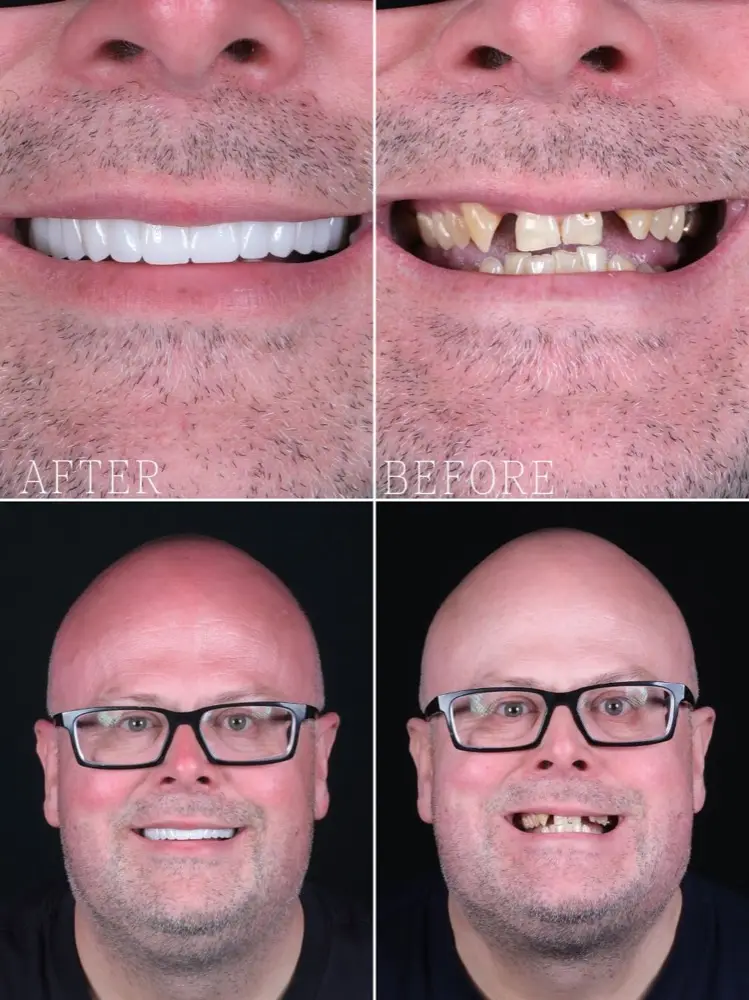
Full mouth crowns
A full set of zirconia crowns, counted tooth by tooth, in one 5-night trip.
Find out more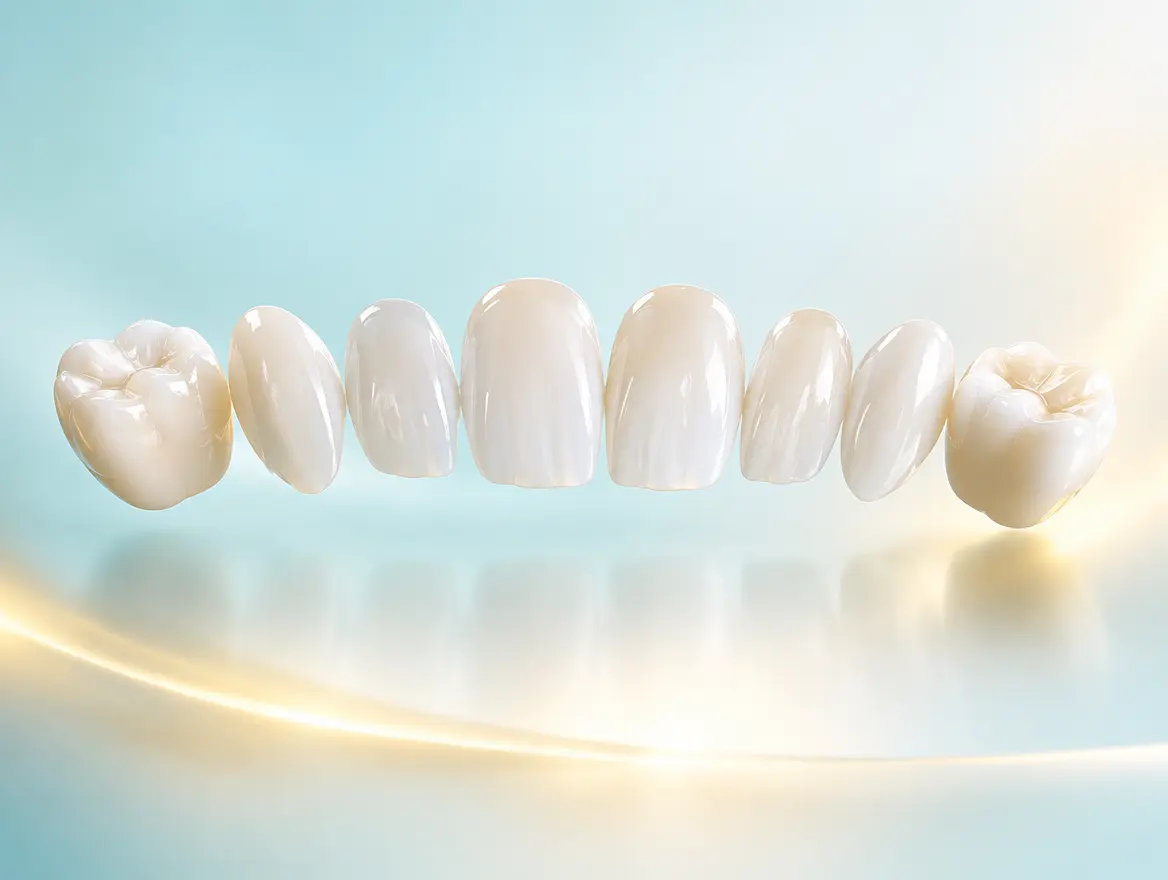
E-max crowns
Translucent lithium disilicate crowns for front teeth, and when zirconia is better.
Find out more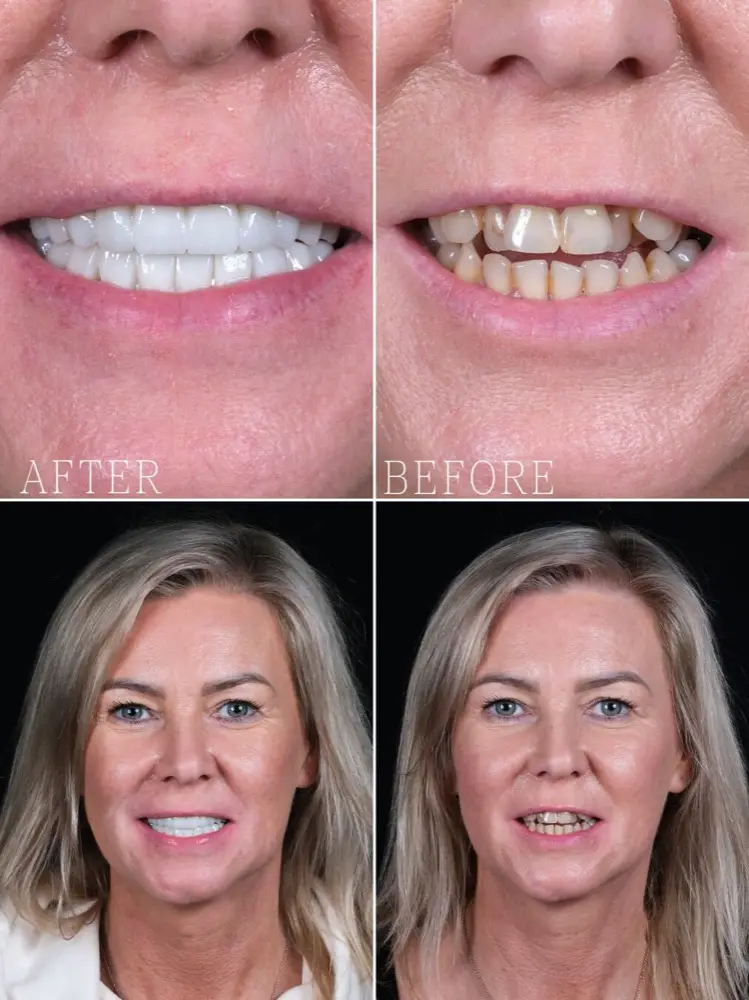
Turkish teeth
Crowns, veneers or your own teeth: an honest plan for a natural-looking smile.
Find out moreAsk a Turkish dentist for a free written plan
Phone photos of your smile or an old X-ray are enough. You get the treatment, the implant brand and the price in pounds on paper, with no obligation to book.